

It is well known that, every day, there are a dozen patent litigation cases filed and that only a very small percentage are prosecuted to an ultimate conclusion at trial. The headlines often focus on the rare billion-dollar verdicts and, consequently, non-specialists cannot have a clear idea of the significance of infringement damages awards and the objective expected net result of this type of litigation.
Thanks to the efforts of the University of Houston Law Center’s Institute for Intellectual Property and Information Law, the question of whether or not litigating patent infringement all the way through trial to a jury verdict has been worth the expense of doing so can be answered with facts. The UHLC has been collecting patent law decisions since 2000 (PatStats), and in this post we use the detailed information from 2005 through the first week of this month. Keeping in mind that the average cost of patent infringement litigation through trial is in the range of $2 million, according to the latest data from the American Intellectual Property Law Association (AIPLA), one question we can answer is: Based on actual damages awards in recent years, are prevailing plaintiffs recovering enough to pay the costs of litigation?
Considering the 284 patent damages verdicts since 2005, the first fact to note is that in 27% of cases the damages award is $0 (zero). Furthermore, up to 37% of cases end with a recovery of less than $250,000. Conversely, two out of every three patent damages awards are for more than $250,000, but 48% are for less than the average cost of litigation mentioned above ($2 million). As the graph shows, multi-million dollar awards are not rare, but only 2% are above half a billion.
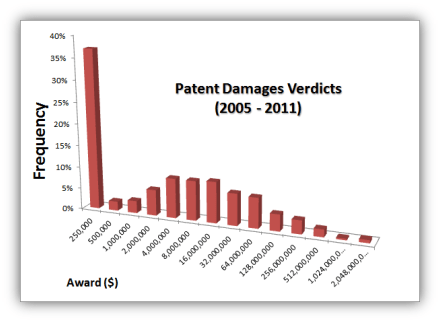
Consequently, without exploring the full scope of information available in the database, at this point we can answer the question posed at the beginning with a resounding maybe; the data shows that the statistical expectation of patent damages awards, net of litigation costs, is approximately $0 (zero). Further, fully 43% of verdicts result in damages awards for double the average cost of litigation, not a bad investment apparently.
Obviously, the key underlying factors in this regard is the size of the market covered by the patents that are worth enforcing and the quality (validity) of the specific patents at issue. In addition, the statistical value of litigating to the ultimate conclusion (zero) clearly explains why most patent lawsuits settle well before spending the full $2 million expected recovery.
 April 26 is World Intellectual Property Day. The date marks the 41st anniversary of the Convention establishing WIPO; the World IP Organization. For the general public, the term “intellectual property” does elicit terms such as copyright, patents, industrial designs and trademarks. For most, these are business or legal concepts with little relevance to their own lives. WIPO’s Member States decided in 2000 to designate an annual World Intellectual Property Day to raise awareness of the important role IP plays in everyday life.
You must be logged in to post a comment.